
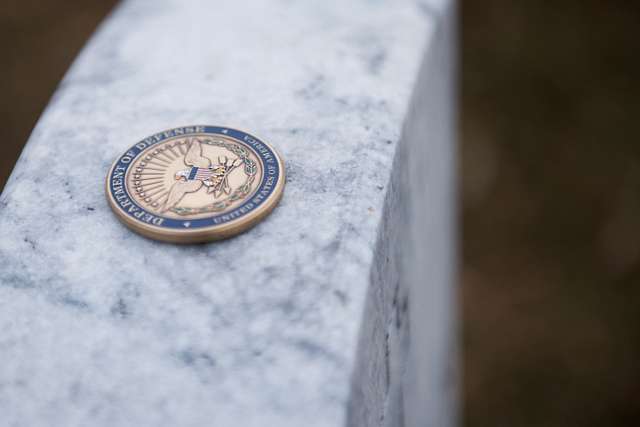
On Veterans Day in 2012, President Obama walked through Section 60 of Arlington National Cemetery, the ground where many of the troops killed in Iraq and Afghanistan are buried. He stopped at headstones, and at several of them he pressed something small and metal onto the top of the white marble, where it caught the light against the stone. He was leaving challenge coins. No speech, no ceremony, just a quiet weight left behind for the dead and for whoever would find them next.


It is worth asking what kind of object a president chooses to leave on a grave. Not a medal, not a flag, not a handwritten note, but a coin. To understand that choice, you have to understand the strange and specific place the challenge coin holds in military life, and how a token born in the field made its way to the most powerful desk in the world.
What a presidential coin actually is
The object on those headstones was an official Presidential Challenge Coin, and it sits at the very summit of the challenge coin tradition. It is commissioned directly by the sitting administration, it is never sold, and it cannot be requested. It is given, by hand, by the president or occasionally a senior surrogate, and that is the only way to get one. Its value has nothing to do with the brass it is struck from and everything to do with who put it in your palm.
That scarcity is what separates it from the other “presidential” coins people run into. Inaugural and campaign coins are commercial keepsakes, mass-produced and sold to anyone who wants one. There are also White House Communications Agency coins, privately funded by the staff who travel with the president to mark specific trips. Both are real and both are collectible, but neither carries the weight of the genuine article: a coin the Commander-in-Chief hands you and no store can sell you. It is, by design, one of the most sought-after coins a person can own.
How a battlefield token reached the Oval Office
The challenge coin itself is much older than the presidency’s involvement with it. Its documented roots run back to the Korean War era, and the legends around it reach further still, full of downed pilots and secret handshakes. That fuller story is worth its own telling, and we cover it in our history of the challenge coin. For most of the twentieth century it was a soldier’s object, passed between people who had served together.
The presidency adopted it almost by accident. During the 1990s, service members meeting President Bill Clinton began doing what they did with any respected figure in their world: they handed him their unit coins. Clinton, recognizing the gesture for what it was, started keeping them. He built a collection displayed on wooden racks in the Oval Office, and those racks were prominent enough to appear in the background of his official portrait, quietly writing the challenge coin into the visual record of the American presidency. Inspired by the exchange, Clinton commissioned the first official Presidential Challenge Coin, and a new tradition was set: a way for the Commander-in-Chief to recognize someone personally, without the paperwork of a formal medal.
A different coin for every presidency
Since Clinton, each administration has designed its own coin, and the designs turn out to be a surprisingly honest record of how each president saw the office.
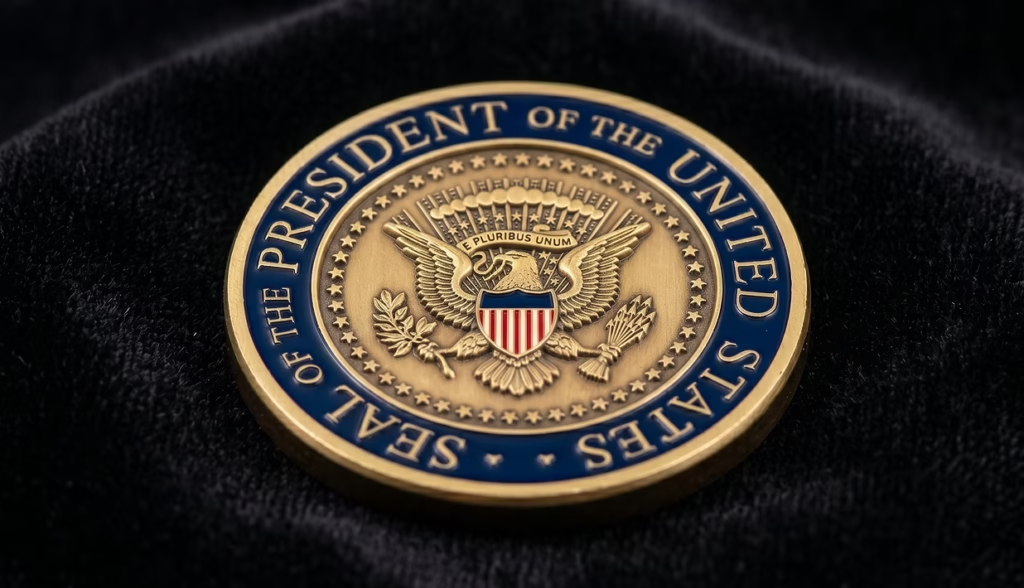
Most are built around the Seal of the President of the United States, which is itself a small masterpiece of symbolism. The bald eagle holds an olive branch in its right talon and thirteen arrows in its left, peace in one hand and readiness in the other, with the motto E Pluribus Unum, “out of many, one,” on a banner in its beak, ringed by fifty stars. Reproducing that much detail on a disc the size of a silver dollar is no small feat, which is part of why these coins are made the way they are.
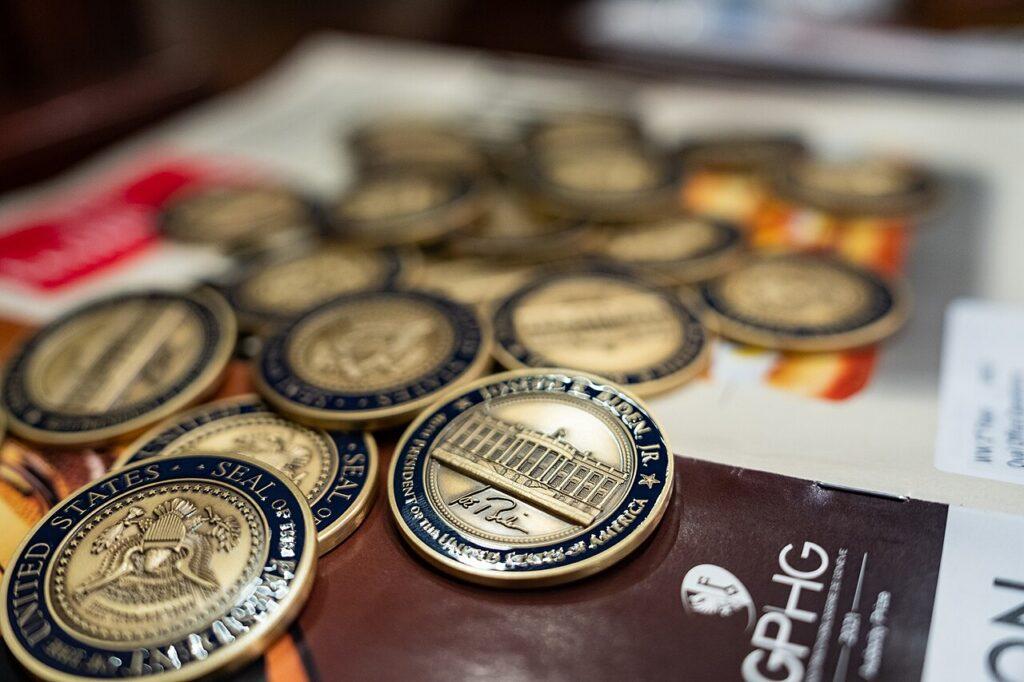
The choices each president made within that frame are telling. George W. Bush, leading during two wars, commissioned a heavier coin that emphasized the eagle, a piece that felt substantial in the hand, and he gave most of his to wounded troops. Barack Obama’s featured a finely sculpted three-dimensional relief of the White House, his signature, and nods to his “Yes We Can” motto and his Nobel Peace Prize, a polished and institutional design. Donald Trump made the sharpest break in the tradition’s history, setting aside the official seal, dropping the thirteen arrows, replacing E Pluribus Unum with his “Make America Great Again” slogan, and thickening the coin so much, with a banner at its base, that it could stand upright on a desk like a trophy rather than ride in a pocket. Joe Biden returned to traditional styling, then folded in something personal: the outline of Delaware and the numerals “261st,” a tribute to the 261st Theater Tactical Signal Brigade, the unit of his late son Beau.
Read in a row, the coins are almost a chart of modern political branding, each one reflecting how its president wanted the office to feel in someone’s hand.
The weight it carries
What makes the coin matter is not the metal but the manner of its giving. The unwritten rule is absolute: a presidential coin is bestowed, never requested. Asking for one breaks the whole spell.
The classic delivery is the so-called secret handshake, where the giver palms the coin and slips it into the recipient’s hand mid-shake, so that to anyone watching it looks like an ordinary greeting. To the person on the receiving end, it is a small shock of recognition, a weight appearing in the palm that means the most powerful person in the country just singled them out. The transfer is so discreet that photographing it is a kind of trophy for White House photographers, and one well-timed 2014 shot caught the edge of Obama’s coin in his palm a heartbeat before the handshake. It does not always go cleanly, either. In 2012, Obama fumbled the move while boarding Marine One and dropped the coin on the tarmac, a small human moment inside a very choreographed ritual.
Presidents have reserved these coins for the heaviest occasions. George W. Bush is generally credited with formalizing the practice of leaving his coins at the headstones of the fallen in Arlington, and he once visited the Vietnam Veterans Memorial off the schedule, with no press, simply to set a coin at the base of the wall. He kept most of his coins for the combat wounded, handing them out at places like Walter Reed. Obama, beyond the Arlington tributes, built a quiet ritual around Air Force One, giving a coin to the service members who stood guard at the foot of the aircraft stairs. On his final flight as president, he stopped at the bottom of the steps to do it one last time.
That is the company this object keeps. It turns up at gravesides, hospital beds, and last flights. No wonder a president reaches for one when words run out.
The maker’s eye: what “presidential-grade” really means
There is a reason these coins can carry that kind of meaning and still look the part, and it comes down to how they are made. As coin makers, this is the part we find hardest to look away from.
Cheap coins are spin-cast, with molten alloy poured into molds, which is fast and soft and leaves rounded, slightly mushy detail. Presidential-grade coins are die-struck instead, blanks of brass or bronze compressed under hundreds of tons of pressure until the metal flows into every microscopic line of a hardened steel die. That is the only way to render something as intricate as the presidential seal, every feather and star and letter sharp enough to read at the size of a coin. Many recent presidential coins push further into deep three-dimensional relief, like the sculpted White House on Obama’s coin, which is a far more demanding cut than ordinary flat stamping.

The finishing is where these pieces become small works of jewelry. Dual plating lets two metals, say polished gold and mirrored silver, sit side by side on the same surface without bleeding together, so the seal or a signature jumps out against its background. The color comes from hard enamel, overfilled and baked and then ground perfectly flush with the metal, leaving a smooth, glass-like face that survives years in a pocket. If you have ever wondered why some coins feel textured and others feel like glass, that is the difference between soft and hard enamel, which we break down in our enamel guide. The best coins are even detailed at the rim, where a jeweler’s lathe cuts faceted patterns into the edge that catch the light as the coin turns.
None of this, it should be said, means a custom maker can put the presidential seal on your coin. Federal law reserves that emblem for official government use, and a reputable maker will tell you so plainly. But every technique behind a presidential coin, the die-striking, the relief, the dual plating, the hard enamel, the cut edges, is exactly what separates a coin that gets treasured for decades from one that ends up in a junk drawer.
The same idea, scaled down
The presidential coin is the summit of the tradition, but it is reaching for the same thing every good coin reaches for. Strip away the office and the seal, and what is left is simple and human: a small, well-made object, given by hand, by someone whose recognition means something to you, marking a moment you earned.
That is the whole idea behind a Marine unit coin, a command coin, a Navy retirement coin, or any custom challenge coin struck for a team that did something hard together. Most people will never receive a coin from a president. But anyone can know exactly who handed them the coin in their pocket, and why, decades later. That is the part worth getting right, whoever you are making coins for.


