Home » Custom Challenge Coins » Custom 3D Challenge Coins

Custom 3D Challenge Coins
A 3D challenge coin sculpts your artwork into real depth, the kind that catches light across an eagle’s feathers, a portrait’s face, or the edge of a building. We are a veteran-owned shop, and we will give you the honest version: 3D is spectacular for the right design and a waste of money for the wrong one. Here’s how to tell the difference.

Why Choose KidderCorp for Your 3D Challenge Coins

Veteran-Owned American Family Business
KidderCorp has been a veteran-owned American family business since 2005. Twenty years of striking coins teaches you where the craft actually lives, and on a sculpted piece is where it shows most. We treat the dimensional work as the part worth getting right, not a box to upcharge.

Free Design & Revisions
Send us a description, a sketch, or finished artwork. Our in-house designers turn it into a production-ready design at no charge, the sculpting work handled in our own shop, with revisions until you sign off. No artwork charges, and no separate die or mold fee.

Designed in the USA
Design and project management happen in the United States. Manufacturing runs through long-standing production relationships overseen by our team, with quality checks on the relief and finish before any coin ships.

Real Law Enforcement Portfolio
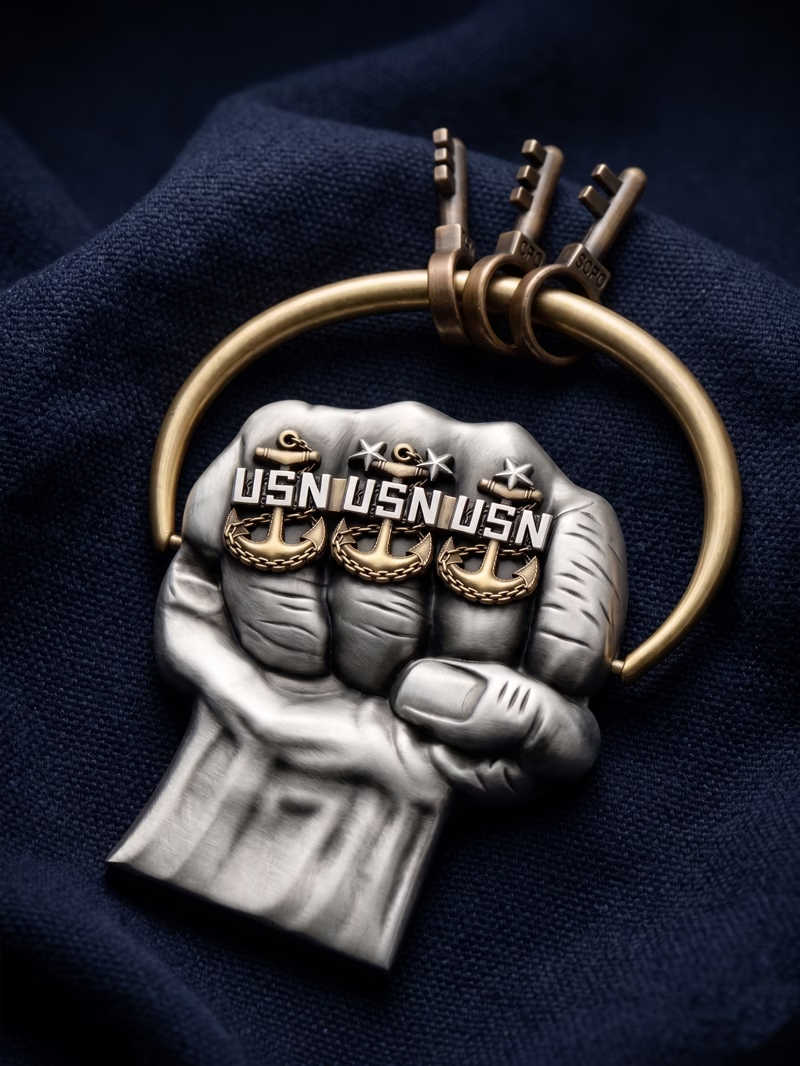
We have built 3D coins for military units, police and fire departments, and private organizations: raised eagles and unit crests, portrait reliefs, detailed badges, and architectural pieces. The gallery further down is real work, not stock renders.
Years of Experience
Orders Completed
Coins Produced
Different Military Units
What Makes a Coin "3D"
Think of coin depth as a ladder with three rungs, not an on-off switch.
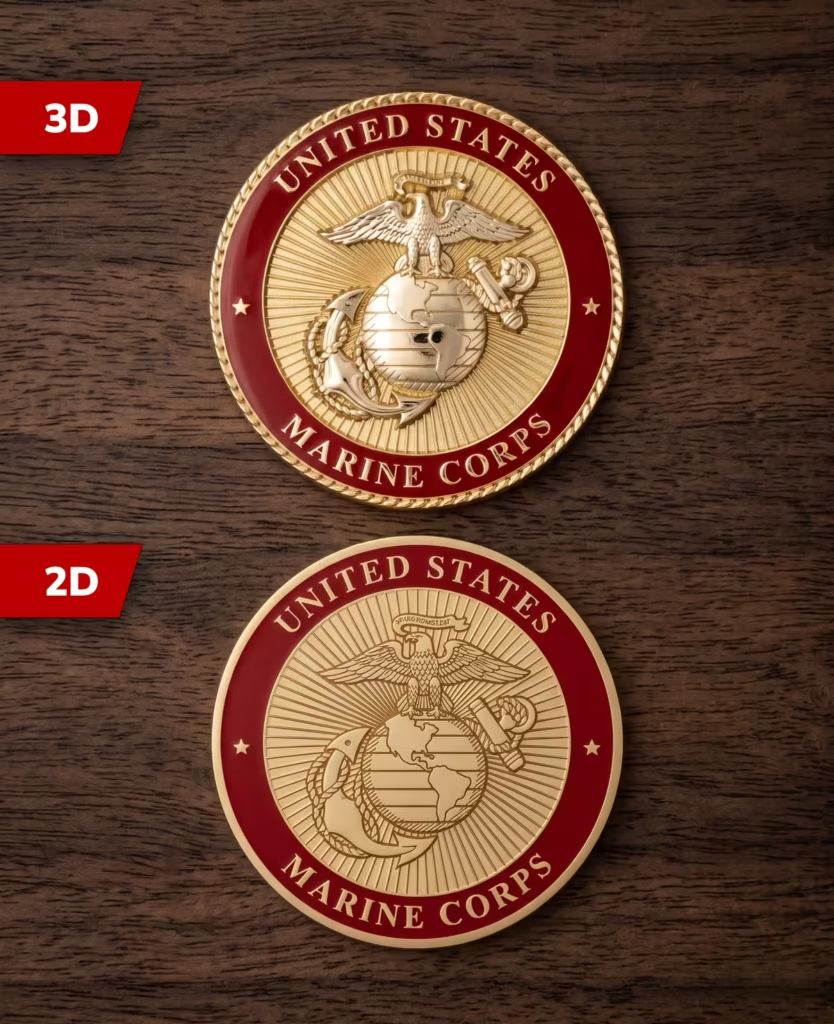
At the bottom is a flat 2D coin. The design sits on two levels, raised metal and a recessed background usually filled with color. One height, clean and graphic, and the right call for plenty of coins.
The middle rung is 3D relief, and it’s where most well-made coins already live. The metal is sculpted with contour, rising and falling across the design the way George Washington’s face curves on a quarter. An eagle gets the round of its chest, feathers that layer, a head that turns. It stops reading as a picture on a coin and starts reading as a small relief carving. Most of our designs carry at least some of this.
Tilt a coin under a light and the difference shows. A flat coin holds still; a sculpted one throws shadow and highlight that shift as it moves, because there’s actual geometry catching the light.
Where the sculpting earns its keep is any design built on form: portraits, animals and mascots, ships and aircraft, badges and crests with real weight. If the subject has dimension in real life, sculpted relief keeps it that way.
There’s one more rung above this, for the rare project that goes all the way.
How We Build a 3D Coin

The whole job is depth, so it starts there. Before any metal moves, your artwork gets turned into a depth model: a map of how high or low every part of the design sits. The eagle’s beak might be the highest point, the feathers stepping down behind it, the background dropping away furthest. This is the stage that separates a real 3D coin from a flat one with a couple of raised bits, and it’s where the sculpting skill actually lives.
That model becomes the die, the hardened steel tool that stamps the coin. A 3D die is cut to hold every one of those depths at once, which is slower and more exacting to make than a flat one. The die is the coin in reverse, and its accuracy is the ceiling on how good the finished piece can be. A soft or shallow die gives you a soft, shallow coin, no finish saves it later.

Then the strike. A metal blank is pressed into the die under enormous pressure, hundreds of tons, so the metal flows into every cavity and picks up the full range of relief in one shot. Heavier coins and deeper sculpts often take more than one strike to fully fill the detail. This is also why 3D coins tend to run a touch thicker: deeper relief needs more metal underneath it to carry the depth, which is part of what gives a good one its heft in the hand.
After the strike comes plating and any color, then a check on the relief and finish before it ships. We’ll get into which finishes flatter a sculpted coin and which fight it in the next section, because that choice makes or breaks how all this depth actually reads.
When 3D Is Worth It, and When 2D Is the Smarter Buy
3D is not an upgrade button you press to make any coin better. It is a technique that fits some designs and fights others, and the only thing that decides it is what you are putting on the coin.
It is worth every penny when the design is built on form. Portraits and faces, animals and mascots with real texture, ships, aircraft, and buildings with depth, eagles and crests where the sculpting gives the emblem weight. If the subject has dimension in real life, 3D keeps it, and the result reads like a small piece of art rather than a token. Bigger coins lean into it even more, since the extra surface gives the sculpt room to breathe.
Where we will talk you out of it is when the design is flat by nature. A coin that is mostly text, a clean logo with sharp lines, or a bold graphic with flat blocks of color does not gain anything from being sculpted, and it can actually lose crispness. Heavy lettering in particular reads sharper on a flat 2D strike than on a sloped surface.
Color is the other deciding factor. Enamel and ink want flat, recessed pockets to sit in. On a sculpted 3D surface there is nowhere clean for color to pool, so a design that depends on lots of bright color usually belongs on a 2D coin. There are ways to add color to 3D, and we cover those next, but if color is the star of your design, flat is the smarter buy.
Design Options for 3D Challenge Coins
Metal Finishes

Antique
(Gold/Silver/Bronze/Copper) Rugged, low-sheen, high-contrast. This is the one we recommend for almost every 3D coin. The patina settles into the low points and the raised areas stay bright, so the contrast does the work of showing off every level of the sculpt.

High Polish
(Gold/Silver/Bronze/Copper) High shine, polished. Sharp and clean, and great for accurate color matches, but the uniform shine gives you less contrast between high and low points, which can flatten how a detailed sculpt reads. Best on simpler 3D or color-led designs.

Black Nickel
A matte, tactical finish, perfect for stealth or modern looks. The one to be careful with on 3D: the dark, low-contrast surface quietly mutes fine sculpted detail. Stunning on a bold flat design, less so on a busy relief.

Dual Plating
Two finishes on one coin (for example High Polish Gold plus Antique Silver) for a high-end, two-tone look. On a 3D piece it earns its keep by picking out a sculpted element, a polished eagle standing off an antique field.
Edges
Classic
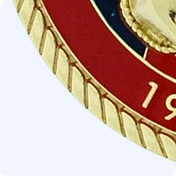
Standard Flat, Rope Cut, or Reeded Edge (Currency style).
Diamond Cut
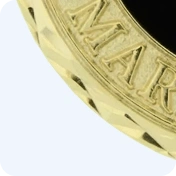
Faceted edges that catch the light like a jewel. Choose from Cross Cut, Spur, Oblique, Diamond, Wave, or Petal Cut.


Simple Ordering Process

Share Your Vision

Review & Approve Your Design

Production & Delivery
What Determines the Price of a 3D Challenge Coin?
Quantity
The biggest lever. Fixed setup costs get spread across the whole run, so the more you order, the lower the price per coin. For a new design we suggest 100 as a sensible starting point. You can order fewer, but below that the per-coin price climbs quickly, since those fixed costs ride on fewer coins. Fully sculpted 4D pieces feel this even more, which is part of why we point most people toward standard sculpted relief.
Size and Weight
Bigger coins use more metal and more striking force, so size moves the price. A larger coin also gives a busy sculpt more room to breathe, so if your design is detailed, the extra size can earn its cost.
Amount of Scuplting
The more 3D contour in your design, the more involved the tooling behind it. Here’s the part worth knowing: we don’t bill that as a separate mold or die fee. It’s built into your per-coin price, so you won’t see the surprise tooling charge that a lot of shops tack on. More sculpting can nudge the per-coin cost, but it’s never its own line item.
Plating and Finish
The finish you choose moves the price. Antique, high polish, and black nickel sit in the standard range; dual plating, two finishes on one coin, sits a little higher for that two-tone look.
Custom Shapes & Cutouts
Standard round coins are the most cost-effective option since they use standard tooling. Custom shapes (badge, shield, star, fully custom outlines) require specialized cutting and a custom die, which adds to the initial cost but produces more distinctive results.
Color & Add-Ons
Translucent enamel, UV printing, and extras like custom edges or cut-to-shape each add a little. We’ll lay out exactly what your design needs when we quote it.
The honest bottom line: the only way to get a real number is to tell us what you’re picturing. Send the idea and a rough quantity and we’ll come back with a quote. Free, no obligation.
What Customers Say About Their 3D Challenge Coins
I have used Kidder coins now for a few coins and for various units. As a Sergeant Major I had some Brigade coins made, now I am a Warrant Officer and had an idea I wanted out into a special coin. I took a few pictures from the internet, my vision, and submitted to Kidder. I could not be more happier with the final product. The customer service is phenomenal and dialogue from start to finish is terrific. What a great company, owned by a Veteran as well! Great job, again!
Josh Winchester
- Verified Customer
Amazing working with Marty and the rest of his team. Very fast response, great designing and artwork experience while ordering a coin for my department – I will definitely use them for the rest of my career!
Dennis Guy
- Verified Customer
Have had the best experience working with Alex, Marty, and Jim at KidderCorp on my custom Commander Coin! Artwork was detailed and seemed to throw off lower-skilled manufacturers, but from the first contact the KidderCorp team has been on it, accommodating the design requests, timeframe (which is tight), and the budget!
We are so excited to see the finished product. I will share a pic as soon as we get it in.
Thank you for your service to and for our country, and for your exceptional service on my project!
- Verified Customer
- Verified Customer
Kidder Corp Coins did a great job designing and producing a beautiful Challenge Coin for the Taffy III Reunion Commemorating the 75th Anniversary of the Battle off Samar. Everyone was impressed and they made a wonderful souvenir for the attendees. Many thanks for your help.
- Verified Customer
Ready to Create Your Custom 3D Challenge Coin?
Takes ~5 minutes. No credit card required. Reply within 24h.
Frequently Asked Questions
How much do custom 3D challenge coins cost?
Pricing matches our standard custom challenge coin pricing. There’s no separate fee or surcharge for police designs. Quantity, size, shape, complexity, finishes, and number of colors all affect the final price. For a typical breakdown, see our pricing guide.
What's the difference between a 2D and a 3D challenge coin?
What is the minimum order quantity?
How long does production take?
Can you help with the design if I don't have artwork?
Do you ship to APO/FPO and international addresses?
What customization options are available?
Do you offer free design revisions?
What file formats do you accept for artwork?
Do you offer rush production?
