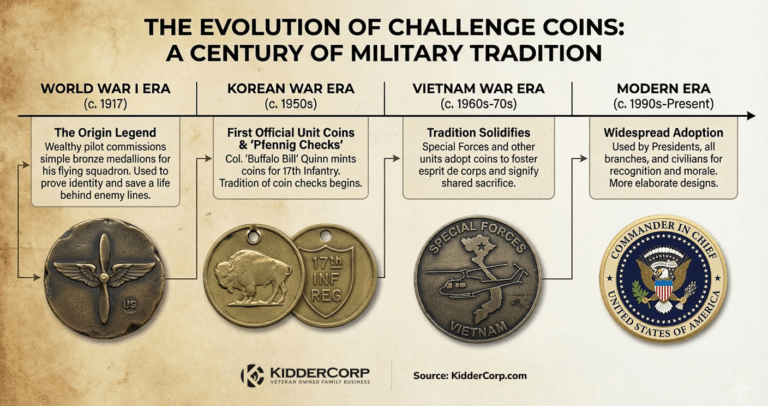
Ask ten different veterans where the challenge coin tradition started, and you will likely get ten different answers.
Some say it started with spies in occupied France. Others swear it began in the bars of Vietnam. The most romanticized version takes us back to the muddy trenches of World War I.
While the exact origin is debated, the result is undeniable. What started as a way to prove identity behind enemy lines has evolved into the military’s most enduring tradition. Today, a coin is more than metal, it is tangible proof of membership.
Here are the three most popular theories on how the challenge coin was born.
Theory 1: The Wealthy Lieutenant (World War I)
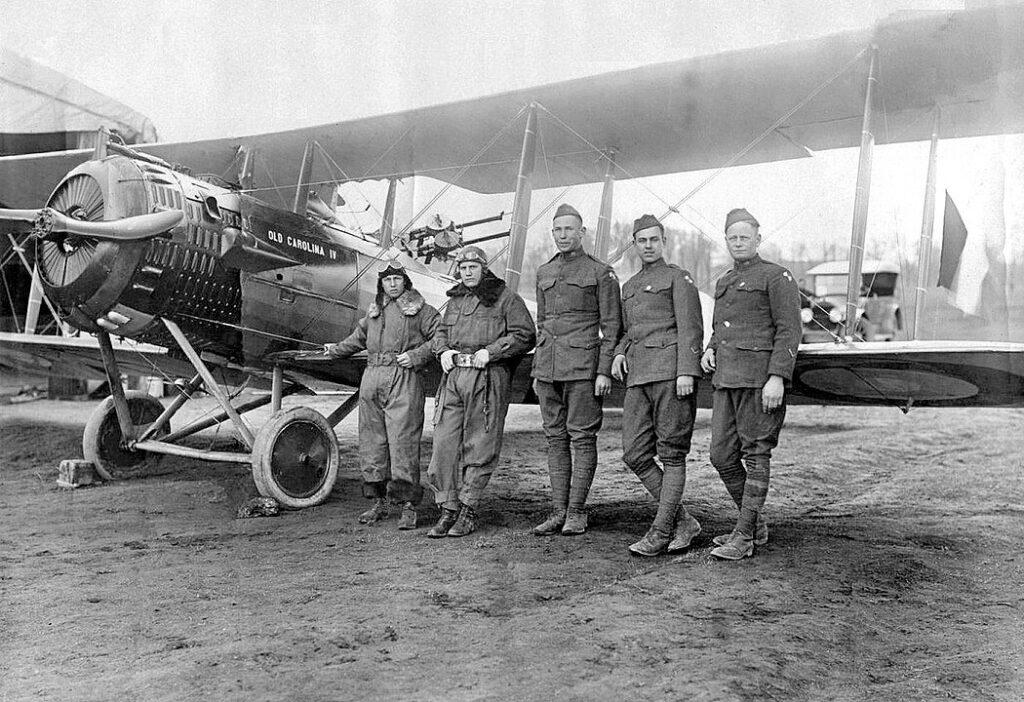
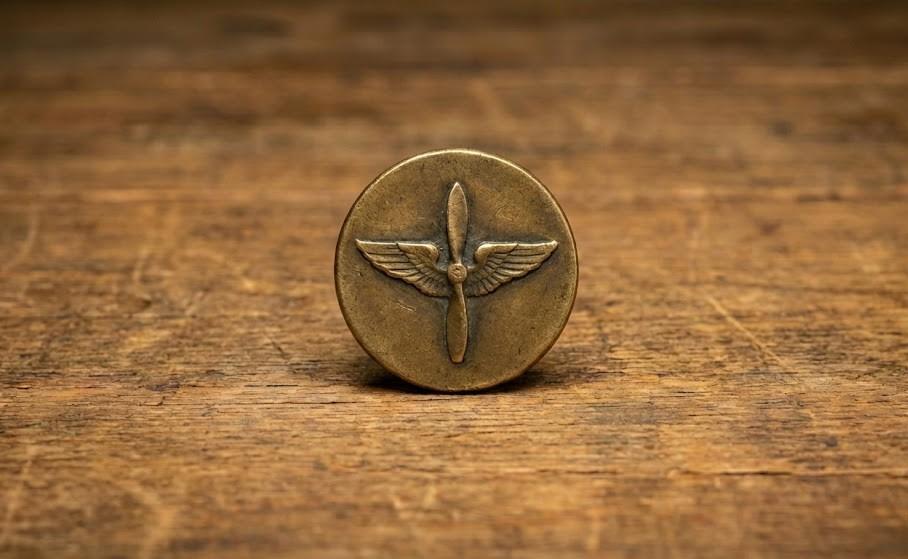
This is the most famous origin story. As the legend goes, a wealthy lieutenant in the Army Air Corps (the predecessor to the Air Force) wanted to give his squadron a memento. He commissioned small, bronze medallions struck with the squadron’s insignia and gave one to every pilot.
One of those pilots, a young man who wore his medallion in a small leather pouch around his neck, was shot down over Germany. He survived the crash but was captured by a German patrol. They stripped him of his uniform and ID, but missed the small leather pouch.
Later, the pilot escaped and made his way across No Man’s Land to a French outpost. The French soldiers, wary of German saboteurs wearing civilian clothes, prepared to execute him. He had no dog tags and no ID. In a last-ditch effort to prove who he was, he produced the bronze medallion.
One of the Frenchmen recognized the squadron insignia. Instead of a firing squad, they gave him a bottle of wine. It became a tradition that saved his life – and sparked a legacy.
Theory 2: The “Jolly Sixpence” (The Spies)
Another theory suggests the tradition is rooted in the clandestine world of the OSS (Office of Strategic Services), the WWII precursor to the CIA.
Agents operating behind enemy lines in France needed a way to verify each other’s identity during meetings without carrying compromising documents. They used specific coins, sometimes a “Jolly Sixpence,” sometimes a specific local coin – as “bona fides.”
If you flipped the coin on the table and the other agent matched it, the meeting was safe. While historically accurate for spies, this theory doesn’t fully explain how the tradition jumped to the regular infantry.
Theory 3: The Vietnam “Bullet Club”
This is likely the true origin of the coin rules we know today.
In Vietnam, Special Forces units and infantrymen carried “lucky bullets”, often the last round in their magazine, kept for a worst-case scenario. At the bar, soldiers would challenge each other to produce their bullet. If you didn’t have it, you bought the drinks.
Over time, live ammunition in a bar became a liability (for obvious reasons). The “bullet check” evolved into a “coin check,” usually featuring a unit-specific coin bearing the crest of the battalion or Special Forces Group.
This was the birth of the drinking game. It wasn’t just about luck anymore; it was about discipline. having your gear on you at all times.
The Modern Era: Presidents and Handshakes

By the 1990s, the tradition had exploded beyond Special Ops. It is widely rumored that President Bill Clinton popularized the “Secret Handshake” pass, transferring a coin from palm to palm during a handshake – within the highest levels of government.
Today, the tradition has crossed over into the civilian world.
- First Responders: Police and Fire Departments use them to mark major incidents or career milestones.
- Corporate: Companies use them to recognize sales achievements.
- Presidents: Every modern U.S. President mints their own official coin to gift to diplomats and troops.
Why the Tradition Matters Today
A challenge coin is one of the few awards in the military that is rarely accompanied by paperwork. It is personal.
When a Commander hands you a coin, they are saying, “I see what you did, and I value you.” When you buy a coin for your Navy or Army unit, you are buying a physical connection to the history of everyone who served before you.
Keep the history alive. Don’t let your unit’s story fade. Mint a coin that future generations of soldiers will trade stories about.