

Ask any sailor, from the freshest Seaman Recruit to the salty Master Chief, and they will tell you the same thing: The Navy runs on coffee, paperwork, and the Chief.
Making Chief (E-7) isn’t just a promotion; it is an induction into a brotherhood. It marks the transition from being a technical expert to being a “Deckplate Leader.” It is the moment you trade your white hat for the combination cover and put on the Khakis.
The Chief Petty Officer (CPO) Challenge Coin is the physical symbol of that transition. It represents the authority, the burden, and the heritage of the highest enlisted leadership in the US military.

Welcome to the Goat Locker
To understand the coin, you have to understand where it lives.
In the days of wooden ships and iron men, livestock was kept aboard vessels to provide fresh milk and meat. The goats, stubborn and tough, were kept in a specific area of the ship. Over time, the Chief Petty Officers, known for being equally stubborn and tough -adopted this space as their sleeping quarters and dining hall.
Today, the CPO Mess is affectionately known as “The Goat Locker.”
A coin bearing the mark of the Goat Locker isn’t just a souvenir. It is a badge of office. It signifies that the bearer has been tested, accepted, and trusted to lead the Fleet.
The “Season” and the Coin
Every year, “Chief Season” (the transition period for Selectees) culminates in the pinning ceremony.
Challenge coins play a massive role in this tradition.
- Selectee Coins: Often designed by the Selectees themselves as a fundraising effort or a unity symbol for their class.
- The Mentor’s Gift: It is common for a sponsor or mentor to hand a newly pinned Chief a specialized coin, often passed during the first handshake in Khakis. This coin marks the moment they stop being a First Class Petty Officer and start being “The Chief.”
Essential Design Elements of a CPO Coin
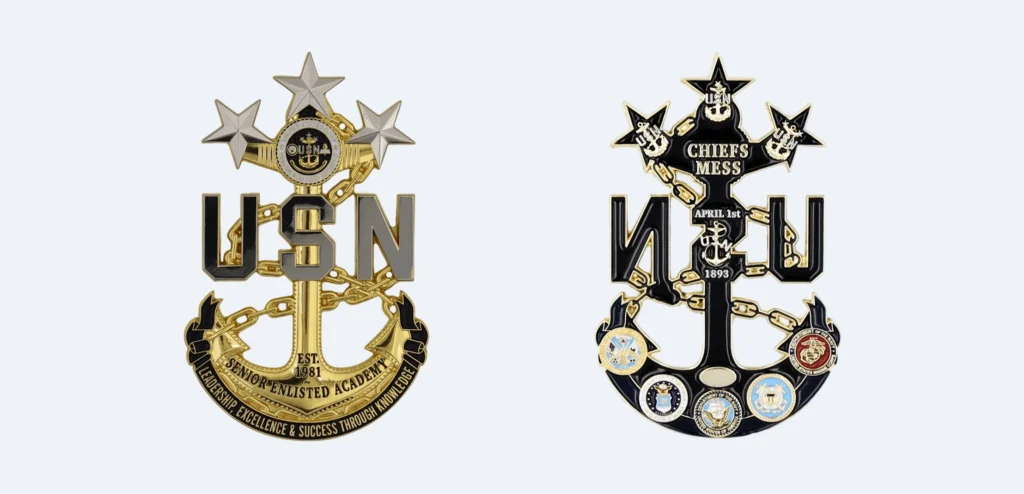
If you are designing a coin for your Mess or for a specific CPO Initiation class, certain symbols are non-negotiable.
- The Fouled Anchor: The universal symbol of the Chief. The “USN” stands for Unity, Service, and Navigation. The chain wrapping the anchor represents the flexibility of the Chief to handle the strain of the Navy.
- The Chain Border: Many CPO coins feature a rope or chain edge, symbolizing the strength of the mess.
- The Skull & Crossbones: Chiefs love “gritty” imagery. From “Jolly Rogers” to Shellback traditions, the skull represents the seriousness of the duty. “Ask the Chief” is often the last thing a sailor hears before the problem is solved—or the discipline is handed down.
- The Goat: The mascot of the mess. Often depicted as an angry, charging ram.
Coin Etiquette in the Mess
A Chief’s coin is rarely just “given” away to civilians or officers. It is earned, or it is traded with other Chiefs as a sign of mutual respect.
The Coin Check Rules apply strictly in the Goat Locker. If a coin is slammed on the mess table, every Chief present must produce their coin.
- If you have it: The challenger buys.
- If you don’t: You are buying the coffee (or the round) for the mess.
Because this happens frequently, durability is key. A Chief’s coin takes a beating. It lives in a pocket with keys, knives, and tools.
Why Weight Matters
A Chief doesn’t deal in lightweight solutions, and they shouldn’t carry a lightweight coin.
At KidderCorp, we recommend Heavyweight Brass for all CPO coins.
- Thickness: Go for 3.5mm or 4mm to give it a satisfying “thud” on the table.
- Finish: We highly recommend Antique Gold or Bronze
 finishes. Why? Because a shiny, polished coin looks new. An antique coin looks weathered, salty, and experienced – just like a Chief.
Summary
Navy Chiefs don’t accept mediocrity. Neither should your coin.
Whether you are designing for this year’s Season, creating a commemorative piece for a retirement, or restocking the Mess, you need a partner who knows the difference between a standard anchor and a fouled anchor.
Ready to mint a coin worthy of the Goat Locker? Start your design with a veteran-owned team that understands the tradition.


